
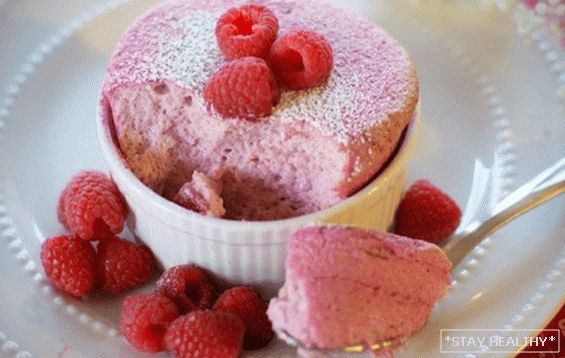
Souffle – tender dessert on gelatin or agar-agar, it
pleases with pomp and light taste, but not always so it turns out.
Sometimes it just doesn’t freeze, reminds semolina or something.
another. There are also options for a hot souffle, which
baked in the oven. This dish is not all that simple either. Analyze
common mistakes?
Contents
Why can’t soufflé on agar-agar
A sweet souffle without baking in the classic version is made on
agar-agar. This is a powder that must be prepared in a special way.
You can find a variety of instructions: insist a few hours
boil a minute or five, cook immediately in syrup or
exclusively in water. Who is right? Need to focus on
instructions. Modern agar-agar often does not require many hours
soaking, it is simply mixed with water and boiled.
Why the souffle on agar-agar does not freeze:
- Disturbed product proportions. In addition to the recipe
It is desirable to coordinate the quantity with the instructions on the package, often
values diverge. It’s wiser to focus specifically on
manufacturer. - Technology is broken. If the recipe says
boil the agar-agar for five minutes, then be sure to note the time,
stir, not going anywhere. - There is no acid. It is necessary to add in the souffle
a little lemon juice, it stabilizes the consistency.
It is believed that the souffle on agar-agar should harden even when
room temperature. This is true, but still it is better to remove the dessert in
refrigerator, there he will get stronger much faster. Besides, if
it is planned to pour the souffle on top with chocolate, preferably
cold base.
Why can’t a soufflé on gelatin
Very often the soufflé is cooked on gelatin. This is done in order to
savings or in the absence of agar-agar. Nothing wrong with gelatin
No, if laid in the norm and previously correctly
to prepare. Even an instant product needs to stand for minutes.
ten or fifteen. If ordinary gelatin is used, then
it is better to leave it for 40-60 minutes.
Errors of working with gelatin:
- Breeding with hot water. As a result, immediately appear
lumps, clots, which then do not dissolve. - Boiling. Gelatin is heated to a liquid in water.
bath, you can not boil. - Do not strain. Gelatin when added to the souffle necessarily
filter to remove small lumps and dense clots,
dried crusts. - Quick reference. Melted gelatin is added at the very end and
extremely thin stream.
Gelatin is not whipped with the rest of the ingredients for a long time, but with
it is important to combine them carefully. Otherwise the soufflé
exfoliate, moisture appears on the surface, dessert is bad
freezes.
Why souffle tight, tough
A good souffle has a fluffy and porous texture;
airy and light. Even a few proteins can make a whole
cake. If the mass is dense, tight, like a frozen semolina
porridge, then obviously something went wrong. Most often the problem is in proteins. Their
you need to beat very well until foam.
Why do not whites whites:
- not fresh eggs;
- dirty dishes or whips mixer;
- the yolk has got to squirrels;
- sugar added immediately.
According to the rules you need to whip in a clean, preferably even fat free,
utensils to a dense foam proteins, only then enter the sugar syrup.
If sand or powder is present in the recipe, they
are introduced after the proteins have thickened.
Otherwise, dense peaks are not achieved. Unlike
agar-agar, this product requires a fridge. It will not freeze when
room temperature. It also takes much longer
sometimes the souffle hardens completely only after five or six hours.
Therefore, professional confectioners with gelatin work not
love
Why souffle is not sweet, not tasty
It so happens that the cooked mass is tasty and sweet, and
the frozen soufflé is no longer so saturated, it is watery, something is not
enough. In fact, this is the case with all desserts. After
cooling they are not so sweet, the flavor is less pronounced. Can
even compare with ice cream. In melted form, it is much sweeter and
more aromatic.
What to do? Just add more sugar to the syrup. For
aroma must pour vanilla, introduce grated zest or
any essences. You need to make the cream slightly sugary to
after solidification, it has not lost its pleasant taste.
Why baked souffle fails.
Soufflé is not always a dessert. Often it’s hot meat
curd or vegetable dish. It also belongs to the French
the kitchen. Despite the same name, the technology is colossal
difference. Both types of soufflé are united only by beating. Baked soufflé
also does not always work. The main problem – it falls after
cooking As a result, instead of an airy and delicate dish, we
get a rubber casserole.
To the souffle from the oven does not fall:
- Bake the souffle to immediately after cooking and
add eggs. The mass should not stand for a minute
therefore we include the oven in advance, give a good warm. - Proteins are added to the mass at the very end and only in
well whipped form. Their нужно довести до плотных
peaks. - You can not put the mass in the form to the very
top. Must remain at least two centimeters free
space. Soufflé is not cupcakes, it doesn’t look out with a hat
must. - Souffle rises best and is cooked in ordinary
Forms with straight walls without bulges and bends.
Figured dishes are undesirable. - After выпечки нельзя сразу вынимать суфле из
ovens. First, let us stand in it, slightly opening
the door. As soon as the mass is strong, cool a little, you can dish
pull out - Often the souffle falls, as it was not banal.
внутри. Cooking temperature and time depend on
included in the ingredients and the recipe itself.
Helpful advice! To get a fluffy and airy souffle,
which does not fall in the oven, you can add an additional one or
even two squirrels. Naturally, beat in a dense foam.
If you believe the French cooks, then the souffle should
fall off. But the weight drops by about 1.5-2 centimeters.
Naturally, if the dish is low and laid out in a wide shape, then it
turn into a flat pancake.
It is advisable to prepare for the selection of suitable
sizes of dishes with high sides from four
centimeters.